
Using Bubble for Building Public Tech Engines That Scale
From civic directories to open data dashboards, Bubble.io is the fastest path to launching a public-facing tech platform without burning your budget.
Public Tech Platforms Are Expensive to Build — Until Now
Governments, NGOs, nonprofits, and civic startups all share one painful reality: they have mission-critical ideas and razor-thin budgets. Building a robust public technology engine — think service directories, grant portals, open data tools, or community reporting platforms — typically requires a full engineering team, months of development, and six-figure budgets.
That equation has changed. Bubble.io, the world’s leading visual development platform, is increasingly becoming the tool of choice for teams that need to launch public-facing digital infrastructure fast, iterate based on real user feedback, and do it all without hiring a large dev team.
Whether you’re a civic tech founder, a development agency building a citizen-facing app, or an NGO digitizing public services in emerging markets, Bubble for building public tech engines is one of the smartest decisions you can make right now.
What Counts as a Public Tech Engine?
A “public tech engine” is any platform designed to serve the public good, coordinate civic activity, or expose data and services to a broad, open audience. These are not internal dashboards or private SaaS tools — they are outward-facing, high-traffic, and often mission-critical.
Here are the most common types we see built with Bubble at SA Solutions:
Civic Service Portals
Platforms that let citizens apply for permits, report issues, or access government services — built in weeks, not months.
Open Data Dashboards
Interactive tools that visualize public datasets — health stats, budget data, environmental metrics — for journalists, researchers, and citizens.
Community Directories
Searchable databases of NGOs, local businesses, health providers, or public institutions, with filtering, profiles, and map integrations.
Grant & Aid Portals
Application management systems that let organizations or individuals apply for funding, track status, and receive decisions digitally.
Public Reporting Tools
Crowdsourced platforms where citizens can flag issues, submit evidence, or share real-time information with oversight bodies.
Volunteer & Resource Matching
Platforms that connect volunteers with NGOs, or match public resources with those who need them most, powered by logic-heavy workflows.
Why Bubble.io Is Purpose-Built for These Use Cases
Public tech engines have specific requirements that traditional development struggles to meet affordably: rapid deployment, frequent iteration, complex data relationships, user roles, and integrations with third-party APIs. Bubble handles all of this natively — and it does so in a visual environment that keeps your team in control of the product.
Here is what makes Bubble uniquely suited for this category of product:
-
✓
Native database with complex relational data — perfect for directories, registries, and case management systems
-
✓
Role-based user access controls — manage admin, reviewer, applicant, and public user roles from one system
-
✓
API integrations — connect to government APIs, mapping services (Google Maps, Mapbox), payment gateways, and SMS/email tools
-
✓
Responsive, public-facing UI — build pages that work across mobile, tablet, and desktop without extra dev effort
-
✓
Scalable hosting on Bubble’s infrastructure — handles traffic spikes common in civic product launches
-
✓
SEO-friendly page structure — critical for public platforms that rely on organic discovery
How SA Solutions Builds Public Tech Engines on Bubble
At SA Solutions, we’ve refined a repeatable process for delivering public tech platforms on Bubble. Led by Athar Ahmad, our team uses a phased approach that eliminates waste, surfaces product risks early, and gets real users on the platform as fast as possible.
Discovery Sprint — Define Before You Build
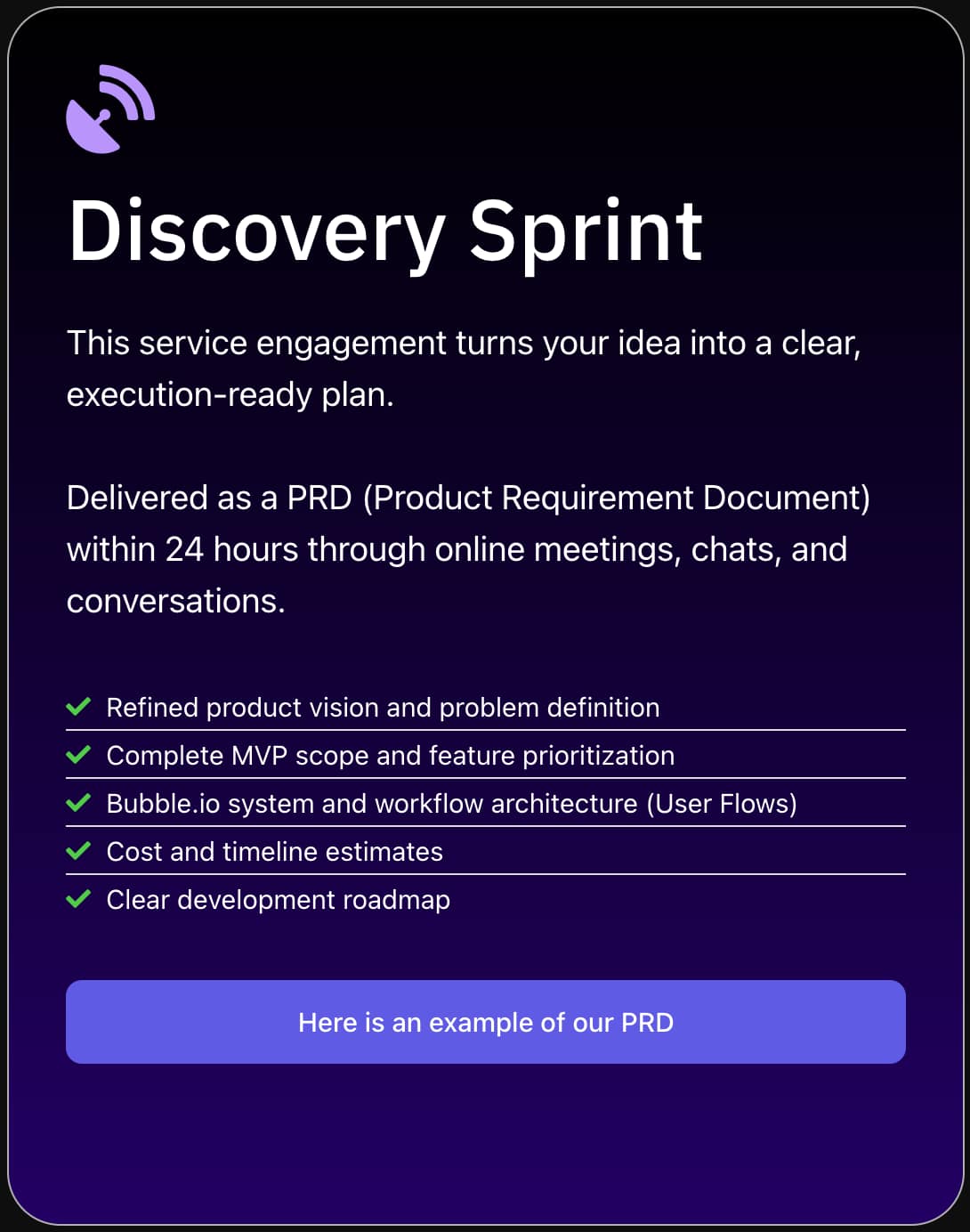
Every public tech engagement starts with our Discovery Sprint. We map your users, define data models, clarify workflows, and prioritize features into a build-ready spec. This prevents expensive pivots after development has started and gives you a clear picture of scope, timeline, and budget upfront.
Architecture & Data Design
Public tech platforms live or die by their data architecture. We design your Bubble database schema to handle the real-world complexity of your use case — whether that’s multi-level location hierarchies, complex application workflows, or large-scale public datasets with search and filter requirements.
Phased Build with Feedback Loops
We build in two-week cycles, delivering working software you can test with real users. This is especially important for public platforms where stakeholder sign-off, accessibility requirements, and community feedback need to be incorporated continuously — not just at the end.
Launch, Optimize & Scale
After launch, we help you monitor performance, optimize slow workflows, and respond to user feedback with rapid iterations. Bubble’s no-code environment means you can make content and logic changes yourself, without developer dependency — giving your team genuine product ownership.
Pro Tip: Start With One Core User Journey
The biggest mistake in public tech projects is trying to serve every user type at launch. Pick your highest-value user journey — e.g., a citizen submitting a service request — and build that end-to-end before adding admin panels, reporting, and secondary use cases. Bubble makes it easy to layer on complexity after you’ve validated the core.
Bubble vs. Traditional Development: The Real Cost Comparison
One of the most common questions we get from NGO leaders and civic startup founders is: “Can we really build something production-grade on a no-code tool?” The answer is yes — and the cost difference is dramatic. Here’s how Bubble stacks up against a traditional custom development approach for a mid-complexity public tech engine:
| Factor | Traditional Dev | Bubble.io (SA Solutions) |
|---|---|---|
| Time to MVP | 4–8 months | 6–10 weeks |
| Development Cost | $40,000–$120,000 | $8,000–$25,000 |
| Iteration Speed | Weeks per change | Days per change |
| Ongoing Dev Dependency | High | Low — team can self-manage |
| Hosting & Infrastructure | Requires DevOps setup | Managed by Bubble |
| Scalability | Custom scaling needed | Built-in, upgrade as you grow |
For mission-driven organizations where every dollar matters, this cost difference is not just convenient — it can be the difference between a project getting funded and approved, or dying in a budget review.
Ready to Build Your Public Tech Engine?
SA Solutions is a certified Bubble.io development agency based in Pakistan, helping civic founders, NGOs, and platform builders launch faster and smarter. Athar Ahmad is a Certified Bubble.io Developer with a track record of delivering complex, public-facing platforms on time and on budget. Start with our Discovery Sprint — a structured engagement designed to clarify your product vision, define your architecture, and give you a roadmap before a single line of logic is built.