
The Complete Bubble.io Enterprise Scalability Audit Framework for 2026
Before your app hits a wall at scale, a structured scalability audit reveals every bottleneck, risk, and optimization opportunity hiding inside your Bubble.io build.
Why Enterprise Teams Are Prioritizing Bubble.io Scalability Audits in 2026
Bubble.io has grown from a rapid-prototyping tool into a legitimate enterprise application platform. In 2026, companies are running mission-critical SaaS products, internal operations platforms, and customer-facing portals entirely on Bubble — some serving tens of thousands of concurrent users. That growth is exciting, but it introduces a hard truth: an app architected for 200 users will not automatically perform well for 20,000.
A Bubble.io enterprise scalability audit is a structured, technical review of your entire application — database design, workflow logic, API integrations, page load behavior, and infrastructure settings — to identify exactly where performance will degrade under load. It is not a vague health check. It is a prioritized action plan that tells you what to fix, in what order, and why it matters to your bottom line.
At SA Solutions, we conduct these audits for funded startups, scale-ups, and enterprise teams that have grown beyond their original Bubble architecture. The findings are almost always the same: a handful of root-cause issues that, once resolved, unlock dramatic performance gains without a full rebuild.
The Seven Pillars of a Professional Bubble.io Enterprise Scalability Audit
A thorough audit covers every layer of your Bubble application. Skipping even one pillar leaves blind spots that can surface as production incidents. Here is the framework SA Solutions uses across every enterprise engagement.
Database Architecture
Review data type relationships, field bloat, list fields vs. linked types, and search constraint efficiency. Poor schema design is the number-one scalability killer.
Workflow Performance
Audit backend workflows for unnecessary loops, synchronous chains that should run in parallel, and recursive triggers that compound under high volume.
API & Plugin Load
Identify third-party API calls happening on page load vs. on-demand, and flag plugins with known performance overhead or deprecated dependencies.
Page & Element Weight
Count repeating group nesting levels, conditional logic stacks, and hidden elements that still load in the DOM — each adds render time at scale.
Capacity Plan Settings
Review your Bubble plan tier, autoscaling configuration, and whether dedicated capacity has been enabled and properly sized for your traffic patterns.
Privacy & Security Rules
Audit data privacy rules for logical conflicts that force full-table scans, and verify that role-based access patterns do not introduce query inefficiency.
Audit Tip: Start With the Database
When time is limited, database architecture always delivers the highest return on audit effort. A single poorly structured data type — for example, using a list field where a linked type belongs — can multiply query time by 10x or more as records grow. Fix the schema first, then optimize workflows around it.
How to Run a Bubble.io Enterprise Scalability Audit: Step by Step
Whether you are conducting the audit internally or working with a certified Bubble.io partner like SA Solutions, the process follows a repeatable sequence. Each step builds context for the next, so do not skip ahead.
Baseline Performance Benchmarking
Before changing anything, document current performance metrics: average page load time, API response times, workflow execution duration, and database record counts per type. Use Bubble’s built-in logs, the Server Logs tab, and external tools like Datadog or New Relic if integrated. These baselines are your before-and-after comparison points.
Database Schema Deep Dive
Export your data type structure and map every relationship. Flag any list fields storing more than 10–15 items, identify missing indexes (simulated through search constraint ordering), and look for data types that have grown far beyond their original intended scope. Document the record counts per type to understand where query load will concentrate.
Workflow & Logic Profiling
Walk through every backend workflow triggered by user actions and scheduled events. Time the execution of the five most-called workflows. Look specifically for “Do a search for” operations inside loops — this pattern creates N+1 query problems that are catastrophic at scale. Flag any workflow that chains more than three consecutive API calls synchronously.
Frontend Element Audit
Review your five highest-traffic pages. Count repeating group nesting depth (more than two levels is a red flag), tally the number of conditional statements per page, and identify any elements that load data on page load that could instead load on interaction. Reducing initial page data load is one of the fastest wins available in a Bubble app.
Infrastructure & Capacity Review
Confirm your Bubble plan aligns with your actual usage patterns. Review whether autoscaling is enabled, understand your app’s average and peak server unit consumption, and evaluate whether dedicated capacity is a worthwhile investment given your traffic volume. Many teams overpay for plan tiers while under-configuring the settings that actually drive performance.
Prioritized Remediation Roadmap
Compile all findings into a prioritized matrix: critical issues that risk production outages, high-impact optimizations with moderate effort, and low-priority polish items. Present the roadmap to stakeholders with estimated effort and projected performance gain for each item. This is the deliverable that transforms an audit from a report into an action plan.
Post-Remediation Validation
After implementing fixes, re-run your baseline benchmarks to quantify improvement. Load-test the application using tools like k6 or Loader.io to simulate concurrent user spikes. Document the new performance baseline and establish a cadence — SA Solutions recommends a scalability review every six months for apps growing faster than 20% month-over-month.
What a Bubble.io Scalability Audit Actually Delivers for Enterprise Teams
The tangible outcomes of a well-executed audit go beyond faster page loads. Enterprise teams that complete a Bubble.io scalability audit with SA Solutions consistently report improvements across four dimensions: user experience, infrastructure cost, developer velocity, and investor confidence.
On the user experience side, reducing page load times from 4–6 seconds to under 2 seconds is common after a database and frontend audit. Workflow failures under load drop dramatically once N+1 query patterns are eliminated. These changes directly reduce churn in data-heavy SaaS products.
From a cost perspective, many teams discover they can downgrade their Bubble plan or delay expensive infrastructure investments by simply optimizing their existing build. One SA Solutions client reduced their monthly Bubble infrastructure cost by 35% after a schema refactor — without migrating to a different platform or rebuilding their app.
-
✓
Faster page loads and API response times across all core user journeys
-
✓
Reduced server unit consumption and lower monthly infrastructure costs
-
✓
Eliminated workflow failures and timeout errors under concurrent load
-
✓
Clear, prioritized technical roadmap for the next 12 months of growth
-
✓
Documented architecture decisions that improve developer onboarding and velocity
-
✓
Investor-ready technical due diligence material for Series A or B fundraising rounds
Frequently Asked Questions
How long does a Bubble.io enterprise scalability audit typically take?
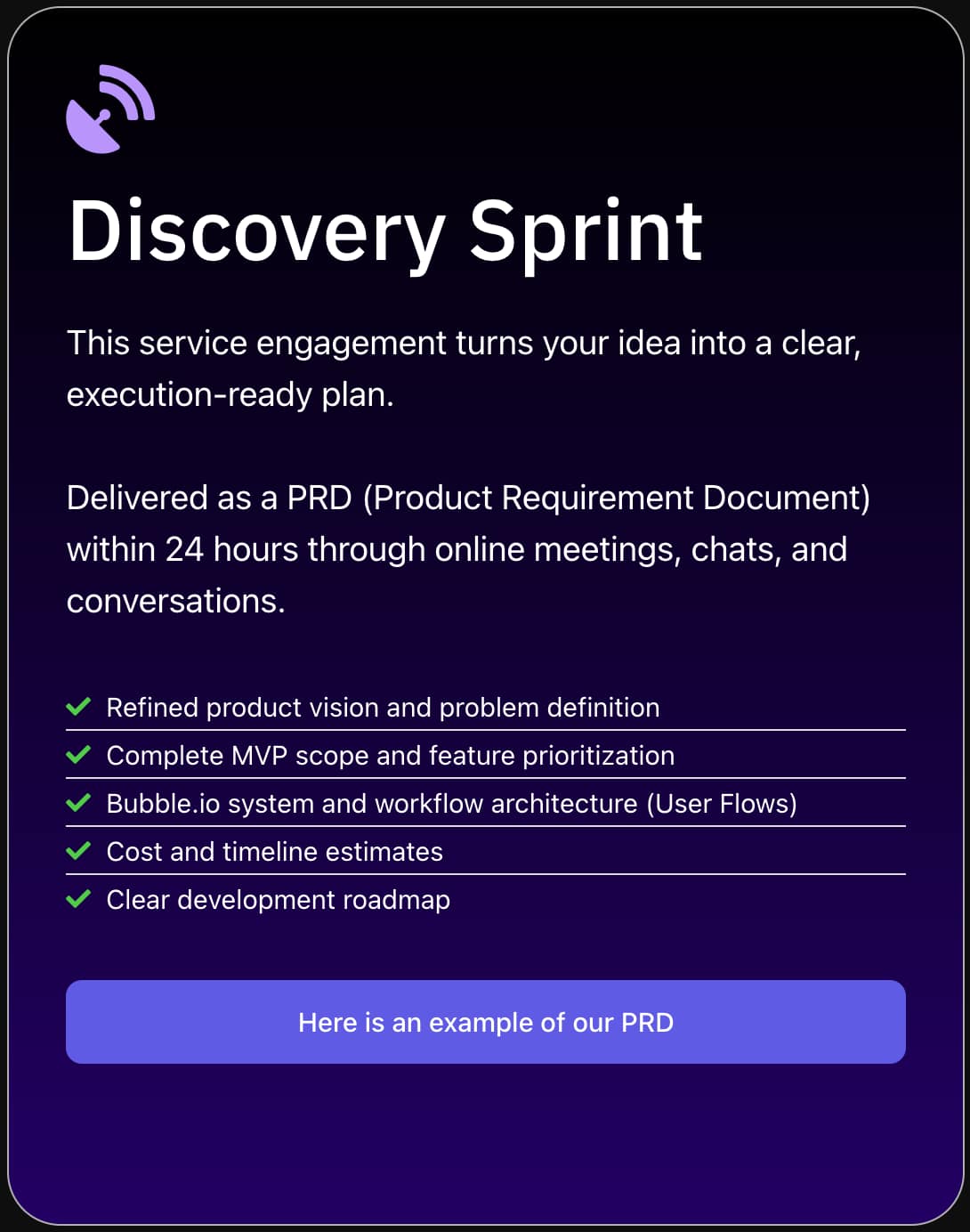
For a mid-size Bubble application with 10–30 data types and moderate workflow complexity, a thorough audit takes between 3 and 7 business days to complete. Larger enterprise apps with 50+ data types, complex multi-role permission systems, and heavy API integrations can require 2–3 weeks for a full audit and prioritized remediation roadmap. SA Solutions can deliver a rapid preliminary assessment within 48 hours through our Discovery Sprint process.
At what stage should a Bubble.io app undergo a scalability audit?
The ideal time for a first audit is when your app approaches 500–1,000 active users or when you are preparing for a marketing push, fundraising round, or enterprise sales cycle that will bring a significant traffic spike. Auditing before performance problems surface — rather than after — is always less expensive and less disruptive. We also recommend a follow-up audit every six months for fast-growing products.
Can Bubble.io truly handle enterprise-level scale, or do large apps need to migrate?
Bubble.io’s infrastructure in 2026 is capable of supporting enterprise applications with tens of thousands of concurrent users when the app is properly architected and running on an appropriate capacity plan. The platform’s dedicated server infrastructure, autoscaling capabilities, and native database have matured significantly. Migration is rarely necessary for performance reasons alone — poor architecture is almost always the actual bottleneck, not the platform itself.
What is the most common scalability issue found in Bubble.io apps?
By a significant margin, the most common issue is “Do a search for” operations placed inside recursive workflows or repeating group cells — creating N+1 query patterns where a single user action triggers hundreds or thousands of individual database queries. The second most common issue is overuse of list fields in data types instead of proper relational linking, which causes full-table scan behavior as record counts grow. Both are straightforward to fix once identified.
How much does a Bubble.io scalability audit cost with SA Solutions?
Audit pricing at SA Solutions is scoped based on application complexity — the number of data types, workflows, integrations, and pages involved. We offer a free Discovery Sprint call where Athar Ahmad reviews your app’s high-level architecture and provides an honest scope estimate before any engagement begins. Book directly via our Calendly link or reach out on WhatsApp to start the conversation with zero commitment.
Ready to Scale Your Bubble.io App with Confidence?
SA Solutions is a certified Bubble.io development agency led by Athar Ahmad. Book a free Discovery Sprint to get a rapid assessment of your app’s scalability risks, a prioritized remediation roadmap, and a clear plan for taking your product to enterprise scale — no commitment needed.