
Bubble.io vs Webflow: Which No-Code Platform Should You Build On in 2026?
The definitive breakdown for startup founders who need to pick the right tool before they spend a single dollar on development.
Why This Comparison Actually Matters
Every week, founders land on this exact dilemma: you want to build fast, avoid six-figure engineering costs, and still ship something that works like a real product. Two names keep coming up — Bubble.io and Webflow. They both carry the “no-code” label, but choosing the wrong one can cost you months of rework and a budget you didn’t plan to burn.
The honest truth is that Bubble.io and Webflow are not interchangeable. They solve fundamentally different problems, and once you understand that distinction, the decision becomes straightforward. This guide will walk you through every dimension that matters — functionality, scalability, pricing, and use case fit — so you can make a confident call before you write a single line of logic or lay out a single pixel.
What Each Platform Actually Does
Understanding the architecture of each tool is the fastest way to cut through the noise. Webflow was built with designers and marketing teams in mind. It gives you pixel-perfect visual control over HTML and CSS, a content management system for blogs and landing pages, and clean code export if you ever need to hand off to a developer. In 2026, it remains the gold standard for marketing sites, portfolio pages, and content-heavy web experiences.
Bubble.io, on the other hand, was purpose-built for web applications. It ships with a built-in relational database, a visual workflow engine for business logic, native user authentication, API connectors, and a plugin marketplace with thousands of extensions. If you need users to sign up, log in, create records, interact with each other, or process payments — Bubble handles all of it without touching a line of code.
Webflow: Design Power
Best-in-class visual CSS editor, responsive layouts, and animation tools for marketing sites and brand experiences.
Bubble.io: Built-in Database
Create data types, define relationships, and store user-generated content — no external database setup required.
Bubble.io: Visual Logic Engine
Build complex workflows, conditional rules, API calls, and automated processes entirely through a drag-and-drop interface.
Webflow: CMS & Integrations
Manage structured content, connect to Zapier or Make, and embed third-party tools for lightweight dynamic content.
Bubble.io: User Authentication
Native sign-up, login, password reset, and role-based permissions out of the box — no third-party auth service needed.
Webflow: Code Export
Export clean HTML, CSS, and JS to host anywhere — a developer-friendly handoff path Bubble.io does not offer.
Bubble.io vs Webflow: The 5 Dimensions That Decide It
Let’s run through the five factors that founders consistently wrestle with when making this choice. Each one reveals a clear winner depending on what you’re building.
Application Logic & Database
If your product needs user accounts, data storage, or any kind of business logic beyond a contact form, Bubble.io wins by a wide margin. Webflow’s CMS is excellent for content but was never designed to power transactional or multi-user workflows. Trying to build a SaaS dashboard or marketplace in Webflow typically requires stitching together five or six external tools — a complexity that negates the no-code advantage entirely.
Design Flexibility & Visual Control
Webflow gives designers a level of CSS control that Bubble.io simply doesn’t match. If your deliverable is a pixel-perfect marketing website with custom animations, parallax effects, and editorial-quality typography, Webflow is the better tool. Bubble.io’s design system has improved significantly in 2026, particularly with its responsive engine, but it still prioritizes function over fine-grained visual craft.
Scalability for Real Products
Bubble.io’s infrastructure has matured considerably, and with dedicated capacity plans and optimized workflows, teams are running thousands of daily active users on production Bubble apps in 2026. Webflow scales well as a content platform but was not architected to handle complex application load. For a growing SaaS or marketplace, Bubble.io is the more future-proof choice.
Pricing & Total Cost of Ownership
Both platforms use tiered subscription models. Webflow’s pricing is generally more predictable for marketing sites, while Bubble.io’s costs scale with workload units and server capacity as your app grows. That said, Bubble.io replaces costs you’d otherwise pay for a backend, database, auth service, and hosting separately — making it highly cost-effective when properly scoped. A well-planned Bubble build from an agency like SA Solutions typically costs a fraction of an equivalent custom-coded application.
Learning Curve & Development Speed
Webflow has a steeper design learning curve for non-designers but can be picked up quickly by anyone with a marketing or content background. Bubble.io requires understanding data modeling and workflow logic — concepts that are closer to software engineering. This is why working with an experienced Bubble.io development agency dramatically reduces time-to-launch compared to learning the platform independently.
When to Choose Bubble.io and When to Choose Webflow
The fastest way to end the debate is to match the tool to the job. Here’s the clear breakdown of which platform belongs in which scenario.
Choose Bubble.io when you need to build:
-
✓
A SaaS product with user dashboards, billing, and role-based access
-
✓
A two-sided marketplace connecting buyers and sellers
-
✓
An internal operations tool or admin panel for your team
-
✓
A web app MVP you need to validate quickly with real users
-
✓
Any product that requires complex workflows, API integrations, or user-generated data
Choose Webflow when you need to build:
-
✓
A marketing or landing page site for a brand or product launch
-
✓
A blog, editorial publication, or content-heavy resource center
-
✓
A portfolio or agency website with high design standards
-
✓
A static e-commerce front-end where Shopify handles the backend
The Hybrid Approach Works Well
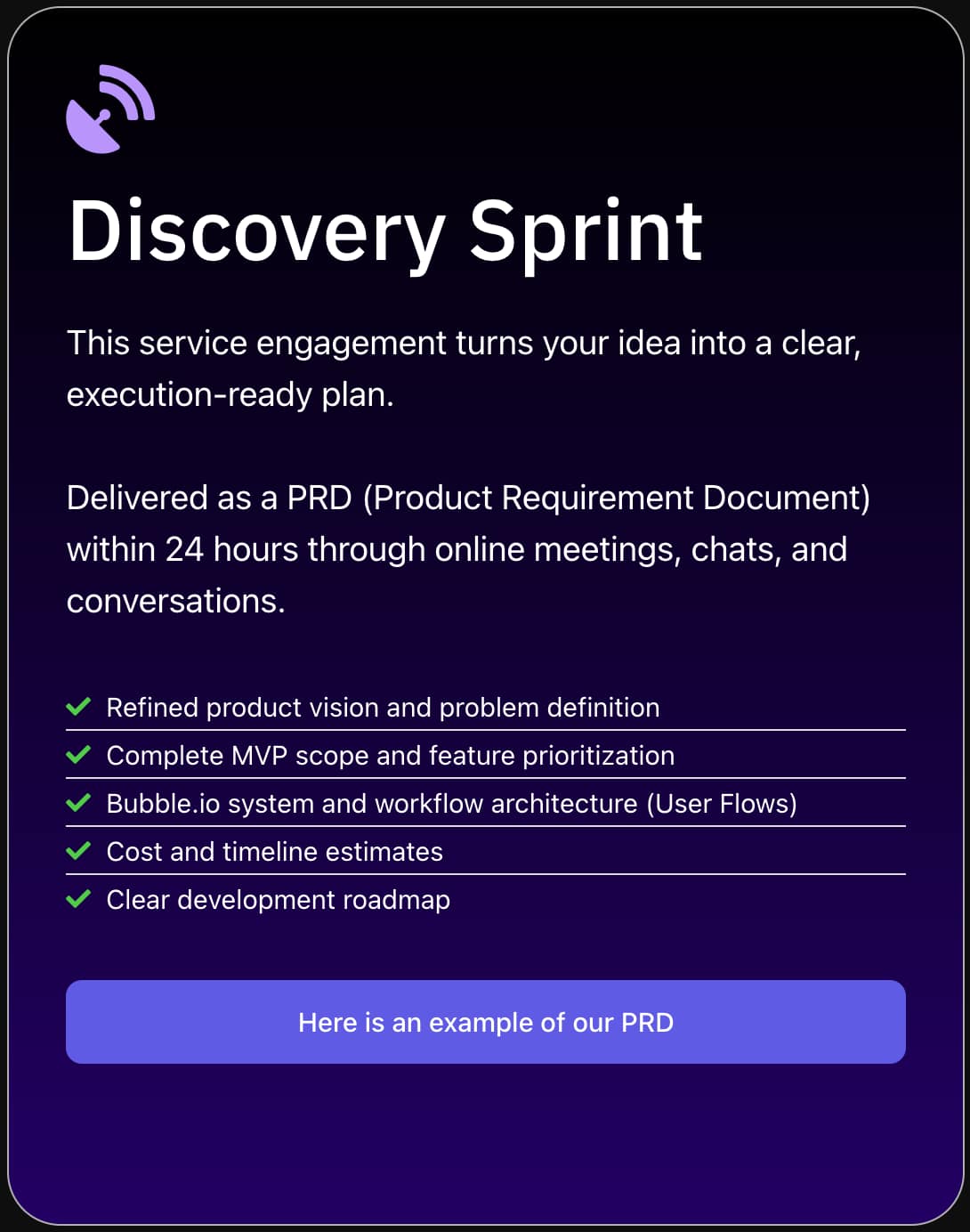
Many mature startups use both platforms together — Webflow for their marketing site and Bubble.io for the actual product behind the login. This gives you best-in-class design for acquisition and best-in-class functionality for retention. SA Solutions has helped multiple clients architect this exact setup during Discovery Sprints.
Why Serious App Builders Choose Bubble.io in 2026
In 2026, Bubble.io has cemented its position as the most capable no-code platform for full-stack web application development. The platform’s native AI features, improved performance infrastructure, expanded plugin ecosystem, and responsive design engine have closed many of the gaps that existed in earlier years. Founders who would have turned to custom code for certain features in the past can now build them entirely within Bubble.
At SA Solutions, our team — led by Athar Ahmad — has delivered dozens of Bubble.io applications for clients ranging from early-stage MVPs to enterprise-grade SaaS platforms. What we consistently see is that founders who start with a structured Discovery Sprint avoid the most common and expensive mistakes: building the wrong features first, under-engineering the data model, or choosing the wrong platform entirely. A 90-minute scoping session saves months of painful rebuilding.
Webflow remains an excellent tool and we recommend it frequently — just not for building applications. If your product lives behind a login and needs to store, retrieve, and act on user data, Bubble.io is not just the better choice, it’s the right choice.
Frequently Asked Questions
Can Bubble.io replace Webflow for a marketing website?
Technically yes, but it’s not the ideal use case. Bubble.io can render beautiful marketing pages, but Webflow offers far greater design precision, animation control, and SEO tooling for purely content-driven sites. If you’re building a marketing site alongside a Bubble app, the hybrid approach — Webflow for marketing, Bubble for the product — is usually the best architecture.
Can Webflow build a full SaaS application with user accounts and a database?
Not natively. Webflow’s CMS is not a relational database built for user-generated data, and it does not support native user authentication or business logic workflows. You could attempt to simulate some of this by integrating Memberstack, Xano, or Make, but the result is a fragile multi-tool stack. Bubble.io handles all of this natively in one platform.
Which platform is more expensive — Bubble.io or Webflow?
Both platforms have comparable entry-level pricing, but costs scale differently. Webflow charges primarily by site plan and CMS items, while Bubble.io charges based on workload units and server capacity as your app scales. When you factor in that Bubble.io replaces the cost of a separate database, backend service, and authentication provider, it typically delivers strong value for application builds.
Is Bubble.io good for building an MVP quickly?
Bubble.io is one of the fastest ways to go from idea to a live, testable product with real users. An experienced Bubble.io agency like SA Solutions can deliver a functional MVP in four to eight weeks, compared to four to six months for a custom-coded equivalent. The key is starting with a solid Discovery Sprint to scope the build correctly before development begins.
Do I need technical knowledge to use Bubble.io or Webflow?
Neither platform requires you to write code, but both have learning curves. Webflow requires understanding of design layout principles; Bubble.io requires understanding of data modeling and workflow logic. Most non-technical founders find it more efficient and cost-effective to work with a certified Bubble.io development agency rather than learning the platform independently while also trying to build a business.
Ready to Build Your App on Bubble.io?
SA Solutions is a certified Bubble.io development agency led by Athar Ahmad. Book a free Discovery Sprint to map out your product scope, timeline, and budget — no commitment needed. We’ll tell you exactly what to build, in what order, and what it will cost.