The Complete Guide to GDPR Compliant Bubble Development in 2026
Everything European startup founders and SaaS builders need to know about shipping privacy-first Bubble.io apps that satisfy regulators — and earn user trust.
GDPR Isn’t Optional — Even for No-Code Apps
If your Bubble.io app collects, stores, or processes data from EU residents, the General Data Protection Regulation applies to you — full stop. It doesn’t matter whether you’re a scrappy two-person startup or a Series A SaaS company. Non-compliance can result in fines of up to €20 million or 4% of global annual turnover, whichever is higher.
The good news is that GDPR compliant Bubble development is entirely achievable. Bubble gives developers fine-grained control over data types, user permissions, API connections, and privacy rules — all of which map directly onto GDPR requirements. The challenge is knowing exactly which levers to pull and in what order.
In this guide, we’ll walk you through every layer of GDPR compliance you need to build into your Bubble app, from data minimisation at the schema level all the way through to subject access request workflows and third-party plugin audits.
What GDPR Actually Requires From Your Bubble App
Before diving into Bubble-specific implementation, let’s ground ourselves in what the regulation actually demands. GDPR is built around seven foundational principles: lawfulness, fairness and transparency; purpose limitation; data minimisation; accuracy; storage limitation; integrity and confidentiality; and accountability. Every technical decision you make in Bubble should trace back to at least one of these principles.
For most Bubble apps, the practical obligations boil down to six areas that need active engineering attention.
Consent Management
Collect explicit, granular consent before processing personal data. Store consent records with timestamps and versions.
Data Minimisation
Only collect fields you genuinely need. Every unnecessary data type is a liability — in your schema and under the law.
Privacy Rules
Bubble’s privacy rules must restrict who can read or modify each data type. Default-open is never GDPR compliant.
Right to Erasure
Users can request deletion of all their personal data. Build automated workflows to handle this cleanly and completely.
Data Portability
Users have the right to receive their data in a machine-readable format. Build export workflows that produce clean JSON or CSV outputs.
Data Transfers
Understand where Bubble (and each plugin) stores data. EU hosting and Standard Contractual Clauses are your primary transfer mechanisms.
How to Build a GDPR Compliant Bubble App: 7 Practical Steps
Here is the exact implementation sequence we follow at SA Solutions when starting any GDPR-sensitive Bubble build. Whether you’re launching a healthcare SaaS, a fintech platform, or an HR tool, this workflow will cover the critical bases.
Audit Your Data Schema First
Map every data type and field in your Bubble app against the question: “Do we actually need this?” Remove or anonymise fields that exist out of habit rather than necessity. This data minimisation exercise is the single most impactful compliance step you can take before writing a single workflow.
Configure Bubble Privacy Rules Properly
Open the Data tab and set privacy rules for every single data type. Never leave a type on the default open setting. Apply “Current User is Creator” or role-based conditions to restrict reads and writes. This is Bubble’s native mechanism for data access control and it maps directly onto GDPR’s purpose limitation principle.
Build a Consent Collection Workflow
Create a dedicated “Consent” data type with fields for: user reference, consent type, consent version, timestamp, and IP address. Trigger this workflow on signup and whenever your privacy policy changes. Store a new consent record — never overwrite the old one. This audit trail is what protects you during a regulatory investigation.
Implement a Cookie Consent Banner
Use a GDPR-compliant cookie consent plugin or an embedded script from a consent management platform like Cookiebot or Osano. Wire the banner’s accept/reject callbacks to Bubble custom states so that analytics and marketing scripts (Google Tag Manager, Intercom, etc.) only initialise after consent is granted. Do not fire any tracking pixels on page load.
Create a Right to Erasure Workflow
Build a backend workflow triggered by a user request (or an admin action) that deletes or anonymises all personal data associated with that user across every data type. Use recursive workflows for large datasets. Test this workflow rigorously — a failed deletion is a compliance incident. Log every erasure request and its completion timestamp.
Build a Data Export (Portability) Feature
Create a backend workflow that aggregates all of a user’s personal data into a structured format and emails it to them as a downloadable file. JSON is preferred for machine readability; CSV works for simpler datasets. This satisfies Article 20 of GDPR and is increasingly expected by enterprise buyers who run their own compliance audits on your product.
Audit Every Plugin and Third-Party Integration
Every Bubble plugin that touches user data is a potential GDPR risk. Check each plugin’s documentation for its data storage practices and geographic location. For plugins that transmit EU personal data to non-EU servers, ensure a Data Processing Agreement (DPA) is in place with the vendor. Maintain a Record of Processing Activities (ROPA) document listing every third-party data processor your app uses.
Pro Tip: Use Bubble’s Built-In User Deletion API
Bubble exposes a native API endpoint for deleting user accounts programmatically. Combine this with your erasure workflow to ensure the Bubble user record itself — including the email address stored in the User table — is fully removed, not just anonymised. This is essential for complete compliance with the right to erasure.
Where Does Your Bubble App’s Data Actually Live?
This is the question most no-code founders forget to ask until a European enterprise prospect asks it for them in a security questionnaire. Bubble’s infrastructure runs on AWS. As of 2026, Bubble offers EU data residency options for apps on their paid plans, allowing you to host your app’s data within the EU (specifically the AWS Frankfurt region). If you’re targeting EU customers, enabling EU hosting should be non-negotiable.
Beyond Bubble’s own hosting, you need to account for every external service your app touches. Stripe, SendGrid, Intercom, Twilio — all of them are data processors under GDPR. Each one requires a signed Data Processing Agreement. Most major vendors provide self-serve DPAs through their privacy portals; make sure you’ve executed them and saved copies.
- ✓
Enable EU data residency in Bubble’s app settings (paid plans)
- ✓
Sign DPAs with all third-party vendors (Stripe, SendGrid, etc.)
- ✓
Document all data flows in your Record of Processing Activities
- ✓
Confirm your sub-processors’ own compliance certifications (SOC 2, ISO 27001)
- ✓
Review Bubble’s own Data Processing Agreement and accept it in your account settings
- ✓
Publish a Privacy Policy that accurately lists all data processors and transfer mechanisms
How We Approach GDPR Compliant Bubble Builds at SA Solutions
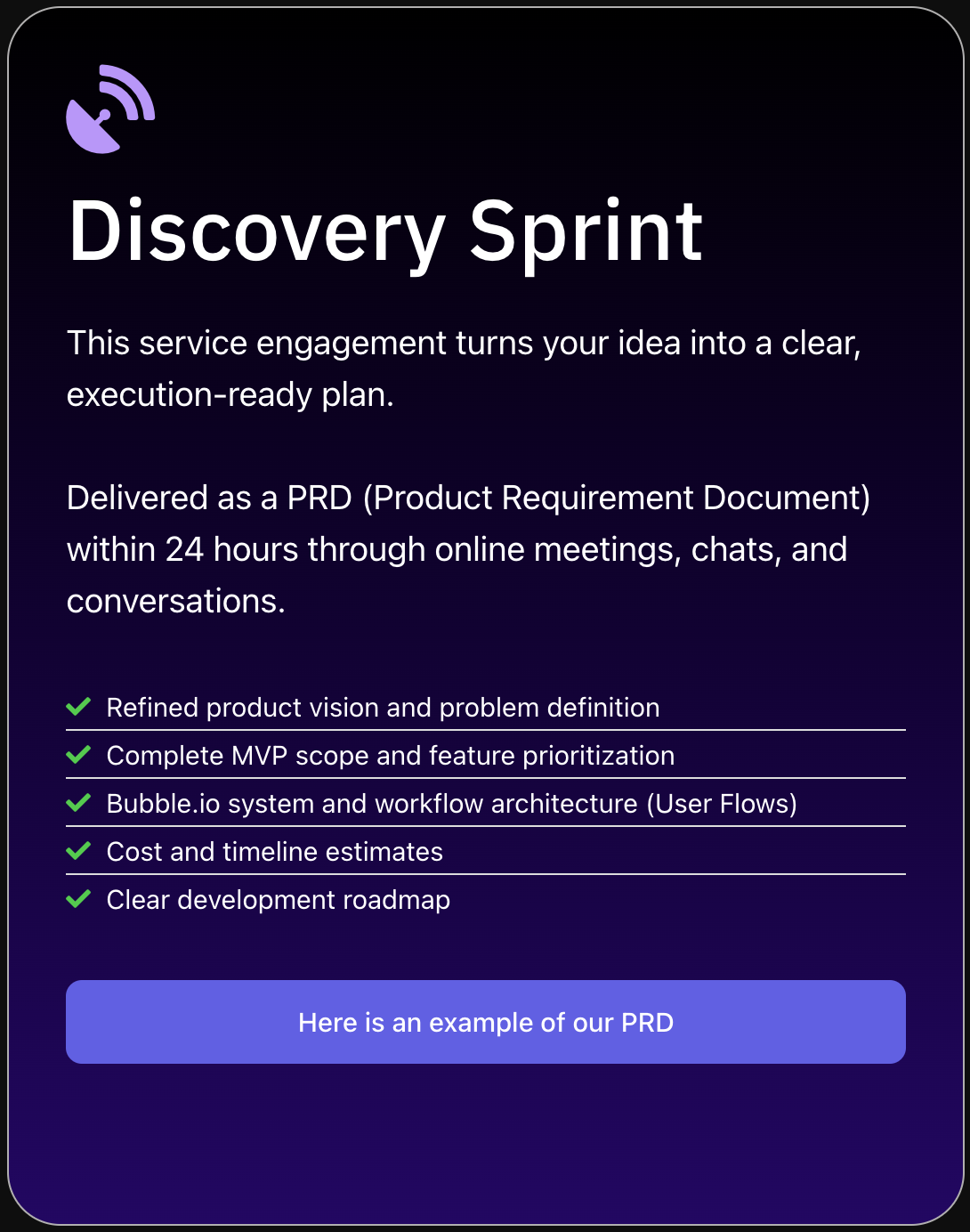
At SA Solutions, GDPR compliance is baked into our development process from the very first session. When you book a Discovery Sprint with Athar Ahmad, one of the first questions we ask is: “Who are your users, where are they located, and what data do you need to collect to deliver your core value?” The answers to those questions directly shape your data schema, your privacy rule architecture, and your consent workflows — before a single element is placed on a page.
We’ve built GDPR-compliant Bubble applications for clients across healthcare, HR technology, legal tech, and financial services. Each vertical has its own nuances — healthcare apps must consider HIPAA alongside GDPR, fintech apps need to think about PSD2 data handling — but the foundational Bubble architecture we use is consistent, battle-tested, and audit-ready.
Our deliverable isn’t just a working app — it’s a working app with documented privacy rules, a tested erasure workflow, an exported ROPA template, and a handover session explaining exactly how to respond to a subject access request. That’s what it means to ship a truly GDPR compliant Bubble development project, and it’s the standard we hold every build to in 2026.
Frequently Asked Questions
Is Bubble.io GDPR compliant out of the box?
Bubble as a platform provides the tools needed for GDPR compliance — including privacy rules, EU data residency, and a Data Processing Agreement — but compliance is not automatic. Developers must actively configure privacy rules, build consent workflows, and audit third-party plugins. Using Bubble doesn’t make your app compliant; building it correctly does.
Can I host my Bubble app’s data in the EU?
Yes. As of 2026, Bubble offers EU data residency on paid plans, hosting your app’s data in the AWS Frankfurt (eu-central-1) region. This is a key requirement for GDPR compliance when serving EU users and should be enabled at the start of your project, not added later. Migrating data residency after launch can be disruptive and costly.
How do I handle the right to erasure in a Bubble app?
Build a backend workflow that systematically deletes or anonymises all personal data fields associated with the requesting user across every relevant data type. Use Bubble’s native user deletion API endpoint to remove the core user record. Log each erasure request with a timestamp, and test the workflow thoroughly to ensure no orphaned personal data remains in related records.
Do Bubble plugins need to be GDPR compliant?
Yes — any plugin that transmits or stores personal data from EU users falls under GDPR’s processor requirements. You must review each plugin’s privacy practices, confirm geographic data storage locations, and execute a Data Processing Agreement with the underlying vendor where applicable. Treat every plugin as a potential sub-processor and document it in your ROPA accordingly.
How long does it take to build a GDPR compliant Bubble app?
Building GDPR compliance into a Bubble app from scratch adds roughly 15–25% to overall development time compared to a basic build, depending on the complexity of your data model and the number of third-party integrations. At SA Solutions, we scope this during our Discovery Sprint so there are no surprises. Retrofitting compliance into an already-live app typically takes longer and carries more risk.
Ready to Build a GDPR Compliant Bubble App?
SA Solutions is a certified Bubble.io development agency led by Athar Ahmad. Book a free Discovery Sprint to map out your data architecture, identify compliance risks, and plan your privacy-first Bubble build — no commitment needed.