Simple Automation Solutions

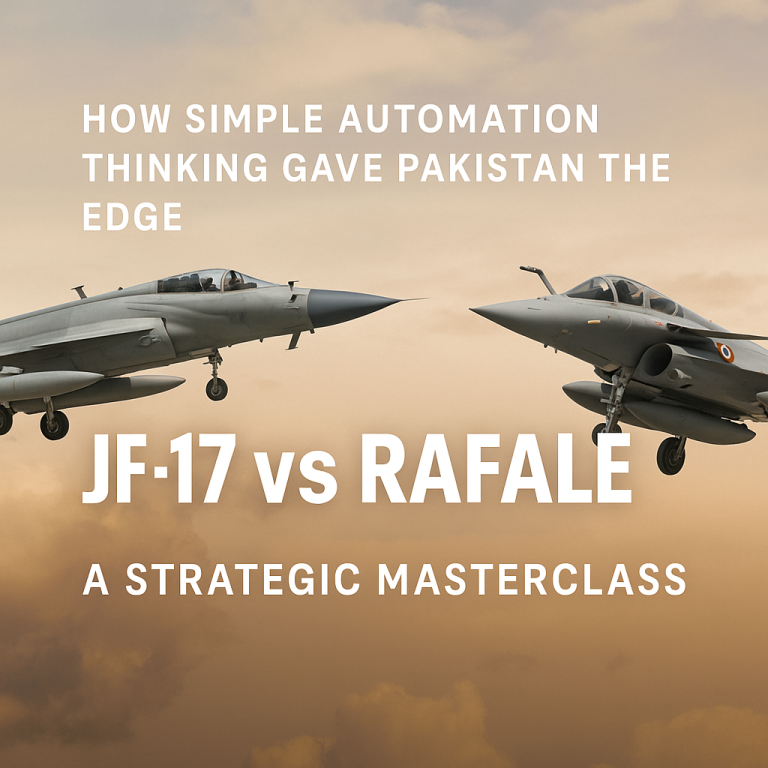
How Simple Automation Thinking Gave Pakistan the Edge: JF-17 vs Rafale – A Strategic Masterclass

How Simple Automation Thinking Gave Pakistan the Edge JF 17 vs Rafale A Strategic Masterclass related to How Simple Automation Thinking Gave Pakistan the Edge: JF-17 vs Rafale – A Strategic Masterclass, by Simple Automation Solutions

How Simple Automation Thinking Gave Pakistan the Edge: JF-17 vs Rafale – A Strategic Masterclass At Simple Automation Solutions, we believe that great systems win not by excess—but by efficiency, adaptability, and strategic control. Pakistan’s JF-17 Thunder fighter jet, developed with similar thinking, proves that smart design always outperforms expensive design—especially in real-world battles. Let’s break down the story of how Pakistan’s JF-17, powered by a mindset of sovereign innovation and iterative improvement, not only rivaled India’s premium Rafale jets, but outclassed them strategically in the 2025 conflict. 🔍 Side-by-Side Comparison: JF-17 Thunder vs Rafale Feature JF-17 Thunder (Block III) Rafale (F3-R Standard) Origin Pakistan-China (PAC & Chengdu) France (Dassault Aviation) Role Multi-role Light Fighter Omni-role Medium Fighter Cost Per Unit ~$25–32 million ~$100–130 million Operational Cost ~$12,000/hour ~$30,000+/hour Radar System KLJ-7A AESA RBE2-AA AESA BVR Missile PL-15 (200–300 km range) Meteor (150–200 km range) Electronic Warfare Modular ECM Pods (Continuously Upgraded) Spectra EW Suite Production Control Fully Controlled by Pakistan Fully Imported by India Export Potential Sold to 3+ countries Not exported by India Strategic Autonomy High – Full Sovereignty Low – Dependent on France ⚔️ 2025 Conflict: When Strategy, Not Spending, Won the Skies In the 2025 India-Pakistan escalation, India’s Rafales were expected to dominate the airspace. Yet, what unfolded was a textbook study/global-financial-meltdown-stock-market-crash-trillions-dollars-loss-amid-global-recession-fears/”>case of how Simple Automation Thinking—agile systems, controlled execution, and modular innovation—can turn the tide. 🚀 JF-17’s Tactical Wins: PL-15 BVR missiles out-ranged Rafale’s Meteor, giving Pakistani jets first-strike capability. Locally optimized ECM systems jammed Indian radar and targeting pods during critical sorties. JF-17s were deployed, re-armed, and launched again in hours—thanks to a lean logistics chain, fully managed by Pakistan’s defense infrastructure. While Rafale relied on costly foreign support, Pakistan maintained operational sovereignty, speed, and agility. 🧠 Strategic Wins Aligned with SA Philosophy: Design for autonomy: JF-17 is not just a jet—it’s a platform Pakistan owns and evolves. Scalable at low cost: Pakistan didn’t just match India’s force—they outnumbered and outmaneuvered it. Adaptive by design: With every new Block (I to III), JF-17 improved—just like SA Solutions’ approach to MVPs and SaaS products. 🛰️ Simple Automation Thinking: The Hidden Hero Behind Pakistan’s Edge What the world saw in 2025 was not just an air battle. It was a battle between two mindsets: One that believes more money means more power. Another that believes better systems win wars. Pakistan chose the latter. And it worked. Rafale was built as a high-end European marvel.JF-17 was built with the mindset of Simple Automation: modular, efficient, scalable, and controlled. Pakistan didn’t just win airspace—they won independence in design, speed in execution, and clarity in doctrine. ✨ Conclusion: Strategy Built on Smart Systems Always Wins At Simple Automation Solutions, we see the JF-17 not just as a jet, but as a case study in sovereign systems thinking. “Victory belongs not to those who spend more—but to those who control more.”Pakistan’s JF-17 program is a real-world proof of that principle. It’s not about flying higher—it’s about flying smarter, faster, and freer.

Case Study: August 2024 Stock Market Crash – A $2.9 Trillion Loss Amid Global Recession Fears

August 2024 Stock Market Crash

On August 2, 2024, the global stock market experienced a significant crash, with $2.9 trillion in market value wiped out due to mounting fears of a global recession. The sell-off was widespread, impacting nearly all sectors and markets. This case–influencer-strategies-for-building-a-massive-following/”>study/case-study-influencer-strategies-for-building-a-massive-following/”>case study examines the factors leading to the crash, the market response, and the potential implications for the global economy. August 2024 Stock Market Crash Key Findings: Recession fears as primary driver: The primary catalyst for the crash was the growing fear of a global recession,particularly in the United States. A disappointing employment report in the US, revealing a cooling jobs market and rising unemployment rate, intensified these fears. Sahm Rule triggered: The US unemployment rate reaching 4.3% in July triggered the Sahm rule, a well-known economic indicator that often signals a recession. This further amplified investor concerns about the economic outlook. Widespread market impact: The sell-off impacted almost all sectors, with technology, communication services,consumer cyclical, and financial stocks among the hardest hit. Even typically defensive sectors like healthcare,consumer staples, energy, and utilities experienced losses. Global implications: The recessionary fears and market crash in the US had a ripple effect on global markets,triggering sell-offs in Europe and Asia. This underscored the interconnectedness of global financial markets and the potential for widespread economic contagion. https://finbold.com/2-9-trillion-wiped-from-stocks-in-a-day-as-recession-fears-mount Analysis The August 2024 stock market crash was a significant event with several contributing factors. The underlying fear of a global recession, fueled by disappointing economic data, created a panic selling environment. The Sahm rule being triggered in the US further solidified these concerns. The market’s response was swift and severe, with a widespread sell-off across sectors and markets. Potential Implications The market crash and recession fears could have several potential implications for the global economy: Economic slowdown: A global recession could lead to a significant slowdown in economic activity, impacting businesses, employment, and consumer spending. Increased market volatility: The market could experience continued volatility as investors grapple with uncertainty about the economic outlook. Policy responses: Central banks like the Federal Reserve may be forced to consider aggressive policy measures,such as interest rate cuts, to stimulate economic growth and stabilize markets. Geopolitical consequences: A global recession could exacerbate existing geopolitical tensions and create new challenges for international cooperation. Conclusion The August 2024 stock market crash serves as a stark reminder of the interconnectedness of global financial markets and the vulnerability of economies to sudden shocks. The potential for a global recession remains a significant concern, and the economic and political consequences could be far-reaching. It is crucial for policymakers, businesses, and investors to remain vigilant and adaptable in the face of these challenges. Daily Express News Disclaimer: This case study is for informational purposes only and should not be considered investment advice. Investing in the stock market carries risks, and investors should carefully consider their investment objectives and risk tolerance before making any decisions.

Case Study: Influencer Strategies for Building a Massive Following

snow top mountain under clear sky

Introduction The rise of social media has transformed the way individuals connect with audiences and build influence. Influencers, individuals with the power to affect the purchasing decisions or opinions of others, have become a significant force in marketing and culture. This study/global-financial-meltdown-stock-market-crash-trillions-dollars-loss-amid-global-recession-fears/”>case study delves into the diverse strategies employed by various influencers across different platforms to build and maintain their massive followings.    1. The role of influencers in the consumer decision-making process – ResearchGate  Case 1: Charli D’Amelio – TikTok Sensation Platform: TikTok Strategy: Charli’s rise to fame can be attributed to her consistent posting of engaging dance videos, often featuring trending challenges and songs. She interacts actively with her audience, responding to comments and messages, which fosters a sense of community. Her collaborations with other TikTok stars and celebrities have also amplified her reach. Case 2: MrBeast – YouTube Philanthropist Platform: YouTube Strategy: MrBeast’s unique approach involves creating high-budget videos with extravagant stunts, challenges, and philanthropic endeavors. His videos often feature large cash prizes and donations, attracting a vast audience. He consistently delivers entertaining content with a feel-good factor, which resonates with viewers.    Case 3: Huda Kattan – Beauty Mogul Platform: Instagram Strategy: Huda Kattan, the founder of Huda Beauty, leverages her expertise and passion for beauty to create captivating content. She shares makeup tutorials, product reviews, and behind-the-scenes glimpses into her life and brand. Her authenticity and openness have garnered a loyal following. Case 4: Joe Rogan – Podcasting Maverick Platform: Podcast (The Joe Rogan Experience)    Strategy: Joe Rogan’s podcast features long-form conversations with diverse guests, ranging from scientists and comedians to athletes and entrepreneurs. His open-minded approach, willingness to explore controversial topics, and engaging interview style have made his podcast immensely popular.    Common Strategies and Insights Despite their diverse approaches, successful influencers share several key strategies: Authenticity: Audiences value genuine personalities and relatable content. Influencers who are true to themselves and their interests tend to resonate better with their followers.    Consistency: Regular posting schedules and consistent content themes help maintain audience engagement and anticipation. Engagement: Interacting with followers through comments, messages, and live sessions fosters a sense of community and loyalty. Quality Content: High-quality production values, visually appealing aesthetics, and informative or entertaining content are essential for attracting and retaining followers. Collaboration: Partnering with other influencers and brands can expand reach and introduce new audiences.    Understanding the Algorithm: Staying informed about platform algorithms and adapting content strategies accordingly can increase visibility and organic reach.    Conclusion Building a massive following as an influencer requires a combination of talent, creativity, dedication, and strategic

Case Study: The CrowdStrike “Blue Screen of Death” Incident

glass panels exterior of the microsoft building

Introduction In July 2023, a widespread technical outage affected millions of Windows users worldwide, causing their systems to crash and display the infamous “Blue Screen of Death” (BSOD). The root cause was traced back to a faulty update of CrowdStrike’s Falcon Sensor, a widely used endpoint security software. This incident serves as a stark reminder of the potential impact of software updates gone wrong, even in the realm of cybersecurity.    1. CrowdStrike’s Faulty Update Leads to Global IT Outage, Disrupting Global Operations  2. Lessons for SMBs from the CrowdStrike-Microsoft Outage – Gusto  Background CrowdStrike is a leading cybersecurity company that provides cloud-based endpoint protection, threat intelligence, and incident response services. Its Falcon Sensor is a lightweight agent installed on endpoints to detect and prevent cyber threats. The sensor regularly receives updates to enhance its security capabilities and address new vulnerabilities.    1. CrowdStrike: Stop breaches. Drive business.  2. What is the CrowdStrike Falcon Platform | Dell Panama  On July 21st, 2023, CrowdStrike released a routine update for the Falcon Sensor. However, this update contained a critical error that triggered a series of events leading to the BSOD crashes. The error caused a conflict within the Windows kernel, the core of the operating system, resulting in system instability and ultimately the crash.    1. Technical Details: Falcon Content Update for Windows Hosts – CrowdStrike.com  Impact The impact of the incident was far-reaching and disruptive. Numerous organizations across various sectors, including airlines, banks, hospitals, and government agencies, reported system outages and disruptions. Some airports experienced check-in system failures, leading to flight delays and manual check-in processes. Financial institutions faced challenges with online banking and transaction processing. Critical infrastructure systems were also affected, raising concerns about potential security risks.    1. CrowdStrike, Microsoft Outage: Is Tech Too Vulnerable? – Georgetown University  2. Global IT outage: Airlines, businesses affected by CrowdStrike, Microsoft issues | AP News  3. Global transport systems struck by IT failure – Airport Technology  The incident caused significant inconvenience and financial losses for affected organizations and individuals. The sudden loss of access to critical systems hampered operations, productivity, and service delivery. The recovery process was time-consuming and resource-intensive, requiring manual intervention and coordination with CrowdStrike support teams.    1. The day IT stumbled: Lessons learned from CrowdStrike outage – Anadolu Ajansı  Root Cause Analysis The root cause of the incident was identified as a faulty code within the Falcon Sensor update. The error caused the sensor to incorrectly flag legitimate Windows system files as malicious, triggering a self-defense mechanism that led to the BSOD crash. CrowdStrike acknowledged the issue and promptly released a fix for the update. However, the damage was already done, and the recovery process was underway.    1. What Code Issues Caused the CrowdStrike Outage? – Sonar  2. Technical Details: Falcon Content Update for Windows Hosts – CrowdStrike  Several factors contributed to the severity of the incident: Wide Deployment: The Falcon Sensor was widely deployed across various organizations and industries, amplifying the impact of the faulty update. Critical Systems: Many affected systems were critical for business operations and service delivery, exacerbating the disruption caused by the crashes. Lack of Testing: The faulty update may not have undergone rigorous testing before deployment, highlighting the importance of comprehensive quality assurance processes for software updates.    Complexity: The interconnected nature of modern IT systems made it difficult to isolate and resolve the issue quickly, leading to prolonged outages. Lessons Learned The CrowdStrike incident offers valuable lessons for organizations and the cybersecurity industry: Rigorous Testing: Software updates, especially those related to security, should undergo thorough testing in controlled environments before deployment to production systems. Rollback Mechanisms: Organizations should have robust rollback mechanisms in place to quickly revert to previous versions of software in study/global-financial-meltdown-stock-market-crash-trillions-dollars-loss-amid-global-recession-fears/”>case of unforeseen issues.    Communication: Timely and transparent communication is crucial during incidents to manage expectations and coordinate recovery efforts. Cybersecurity Awareness: Organizations should regularly review and update their cybersecurity policies and procedures to mitigate risks and respond effectively to incidents. Conclusion The CrowdStrike “Blue Screen of Death” incident serves as a cautionary tale about the potential risks of software updates and the importance of robust cybersecurity practices. While the incident caused significant disruption, it also highlights the resilience and adaptability of organizations in the face of unexpected challenges. By learning from this incident, organizations can strengthen their cybersecurity posture and minimize the impact of future incidents.